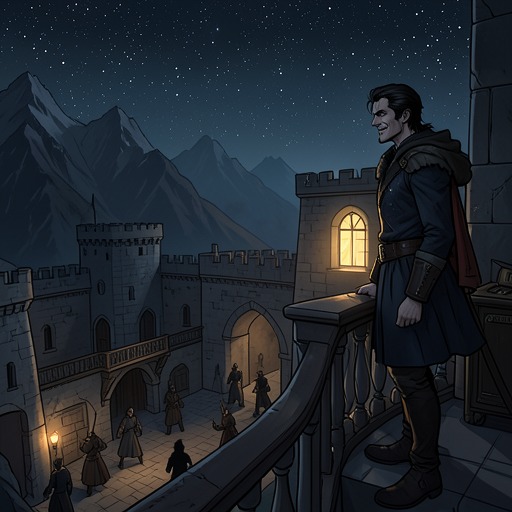
Second Trial: Three Levers
A Court of Thorns and RosesSecond Trial: Three Levers is the second of Amarantha’s three tasks for Feyre Archeron, a deliberately engineered contest in which freedom, loyalty, and life itself are made dependent on solving an incomprehensible written puzzle. The trial is designed not merely to test intelligence but to convert fear into public entertainment: Feyre must act under a visible deadline, with Lucien’s death placed directly before her and failure presented as both punishment and spectacle.
Causes and Background
The trial follows Amarantha’s bargain with Feyre. Amarantha offers to break Tamlin’s curse and release Tamlin and his court if Feyre completes three challenges proving the depth of her human loyalty and love. She also offers an alternative: Feyre may answer Amarantha’s riddle at any time, but an incorrect answer will bring the kind of fatal consequence already represented by Clare Beddor’s death. The bargain therefore gives the appearance of choice while keeping Feyre inside a structure controlled by Amarantha, whose wording and magical precision make every loophole dangerous.
The challenge also exploits information that has been gathered about Feyre. Amarantha knows from Rhysand that Feyre is a huntress, a fact she uses to frame the first trial’s demand to hunt. In the second trial, by contrast, she attacks a different vulnerability: Feyre’s inability to read the language carved into the chamber wall. The task is thus not a neutral test of reasoning. It is an asymmetric game in which Amarantha selects the conditions, controls the information, supplies the audience, and determines the consequences of error.
The Chamber and Its Stakes
Amarantha summons Feyre to a smaller cavern with gilded walls and no furniture. Tamlin stands behind the queen, while the Attor waits nearby, its long tail slashing across the floor and its smile intended to unsettle her. When the task begins, the floor shudders and sinks, lowering Feyre into a large rectangular pit. Three walls are smooth, polished stone, too flat to climb; the fourth is an iron grate dividing the chamber in two.
On the opposite side lies Lucien, chained to the center of the floor. His remaining russet eye is wide with terror, his metal eye spinning wildly, and the scar across his face stark against his pale skin. The arrangement makes him both hostage and instrument: Feyre cannot reach him, yet she must watch his danger. Above them, two enormous spike-encrusted grates that had looked like chandeliers begin descending. Their spikes glow red with heat, and the mechanism is designed to crush Feyre and Lucien rather than grant either of them a clean death.
Amarantha identifies the rules with calculated simplicity. Feyre must answer the question by selecting the correct lever; choosing incorrectly will bring doom. There are three options, marked I, II, and III, and the descending grates impose a rapidly closing deadline. The wall bears a lengthy inscription, but Feyre recognizes only basic words such as “the,” “and,” and “went.” The rest is a blur of unfamiliar letters, and the timing makes ordinary study impossible. The scene converts literacy into a weapon: the apparently intellectual puzzle is inseparable from bodily exposure, heat, confinement, and the imminent destruction of two prisoners.
The Choice and Its Reversal
Feyre begins by searching for meaning in the inscription while the spikes descend and the heat gathers around her. Her inability to read leaves her without the normal means of solving the puzzle, so the trial shifts from interpretation to dangerous inference. She reaches toward the first and middle levers, but pain stops her fingers. The punishment is not theoretical; the wrong options are actively defended against her touch, while the correct route remains concealed behind uncertainty.
Rhysand becomes the crucial, ambiguous source of guidance. Through the grate, Feyre finds his star-flecked violet gaze, while his face remains a mask of boredom. She can only trust him, and that trust is itself another form of risk: he does not openly explain the answer, and she must interpret the limited signal available to her. When she reaches for the third lever, she feels no pain. The distinction between the options supplies the information that the inscription withholds.
Feyre nevertheless has to act before certainty is possible. With the spikes almost at her head, she closes her eyes, unable to look at Tamlin, and pulls the third lever. Silence follows. The heat does not move closer; then Lucien exhales. The spikes remain suspended only inches above Feyre, and the grate finally groans upward, allowing cool air to flood the chamber. The reversal is immediate and physical: the mechanism that seemed certain to kill them stops, and Feyre’s forced reliance on Rhysand becomes the means of survival.
Consequences and Significance
The successful choice preserves Feyre’s life and prevents Lucien from being crushed, while allowing Feyre to continue Amarantha’s larger bargain. It also advances the struggle over Tamlin’s curse and the freedom of the Spring Court, although the trial does not release them by itself. Instead, victory carries Feyre deeper into the sequence of ordeals, where each apparent success produces another demand rather than genuine safety.
The trial’s central value shift runs from apparent death to temporary survival, but its deeper movement is from isolation to precarious alliance. Feyre enters the pit deprived of language, escape, and reliable knowledge; she leaves it having made a correct decision through observation and trust. Amarantha’s public game is therefore not defeated by superior control of the rules. It is disrupted when Feyre recognizes the pattern of the trap and accepts help from a figure whose motives remain difficult to read.
As part of the wider trial structure, the three levers also sharpen the contrast between Amarantha’s claims to fairness and the coercive reality of her rule. Her bargain presents the challenges as proof of devotion, yet the second task places an unreadable inscription, a chained ally, and lethal machinery against a captive under a cheering or wagering audience. The event makes visible how power turns judgment into spectacle: Amarantha does not simply punish Feyre; she makes everyone watch whether Feyre will live, whether Lucien will die, and whether a single gesture can interrupt the queen’s intended ending.
The trial’s ritual setting further enlarges its meaning. Earlier ceremonies in Prythian, including Calanmai and the Great Rite, are described as communal exchanges through which magic is renewed and returned to the earth; the trial reverses that logic. Here, bodies are not joined to sustain a court or season but separated, imprisoned, and placed beneath descending iron. The chamber is a counterfeit ritual space in which Amarantha stages authority through rules, witnesses, and sacrifice. Feyre’s successful choice does not restore that community, but it creates the smallest possible counter-ritual: one person reads pain, silence, and trust correctly enough to refuse the death prepared for her and Lucien.